Code has become a commodity.
As I argued in Code is Cheap, Context is King, the real engineering bottleneck is no longer typing syntax. It is managing context.
This is why prompts are not enough. In the messy, high-stakes reality of enterprise software engineering, prompts are just conversations. And conversations, by nature, are ephemeral, context-poor, and full of noise.
The only way to manage context deterministically in an AI-driven environment is to move away from casual prompting and embrace the architecture of Skills.
In this article, we will deconstruct a generic but real-world Skill pattern: bug-scout. Think of it as a short, memorable name for a CI failure Skill. Its purpose is to ingest an automation failure, investigate the evidence, perform deep Root Cause Analysis (RCA), and propose a clean Jira bug only when the confidence threshold is high enough. A sanitized public version is available as the Bug Scout Skill pattern in the TestShift AI GitHub repository. We will explore why this architecture is powerful, where it needs strict governance, how it lowers the historical wall between QA and Development, and what it signals about the future of software engineering.
What Is a Skill, and Why Is It the Heart of Agentic AI?
A prompt is a one-off request:
Summarize this error.
A Skill is a governed behavioral contract.
It defines an autonomous agent’s operational boundaries, its allowed data sources, the tools it can invoke, the output format it must produce, and, most importantly, what it is strictly forbidden to do.
As detailed in The Rise of Autonomous AI Agents in Playwright, autonomous agents require rigid guardrails. Without them, they hallucinate, overreach, or optimize for plausible completion instead of engineering truth.
The Skill is the perimeter fence that grounds the agent in the reality of your specific organization.
Strictly speaking, a Skill is not “compiled” the way TypeScript or Go is compiled. It is still interpreted by an LLM at runtime. That is exactly why the contract matters: negative constraints, allowed tools, confidence gates, and human approval compensate for the model’s non-determinism.
When we create a dedicated Skill like bug-scout, we are encoding the muscle memory of a Staff-level Quality Architect into a Markdown or YAML contract. We are transforming human triage intuition, historical debugging habits, and hours of manual investigation into a machine protocol that can run on every pipeline failure.
That is the real shift:
Prompting asks the model to behave. Skills constrain the system so behavior becomes repeatable.
Deconstructing the RCA Skill: Anatomy of Engineering Leverage
The bug-scout Skill is not just a text summarizer. It is a logical investigation engine.
Its value is not that it writes nicer Jira tickets. Its value is that it forces the agent to reason over evidence in a governed path.
1. The Power of Negative Constraints
The genius of this Skill lies not only in what it asks the AI to write, but in what it forbids the AI from writing.
LLMs suffer from verbosity. They love long templates, investigator notes, empty sections, medium-confidence speculation, and polite filler that nobody in a delivery team has time to read.
A strong bug-intake Skill cuts through that noise aggressively:
- Do not include empty sections.
- Do not leak internal reasoning into the ticket body.
- Do not include Medium or Low RCA rows that dilute the signal.
- Do not create a bug when evidence is too weak.
- Do not confuse automation flakiness with a product defect.
Important distinction: weak claims should be suppressed inside a Jira proposal, but weak signals should still be classified honestly at the workflow level as insufficient evidence.
This matters more than most teams realize.
In enterprise delivery, the cost of a bad Jira ticket is not the ticket itself. The cost is the ping-pong: QA explains, Dev asks for proof, QA adds logs, Dev says it cannot reproduce, everyone loses context, and the release train burns time.
A Skill that suppresses noise is not a writing tool. It is an organizational friction reducer.
2. The Correlation Engine
Instead of merely staring at a stack trace, the Skill behaves like a forensic investigator.
It is instructed to find the smoking gun:
- Search historical bugs labeled
FoundByAutomation. - Inspect recent pull requests in relevant repositories such as
frontend-app,backend-api, orpayments-service. - Cross-reference timestamps: when did the test last pass, when did it first fail, and which PRs merged inside that window?
- Compare failing locators, API responses, test metadata, environment, service type, plan type, and domain-specific variables.
This is the architectural jump.
The AI is no longer reporting a symptom:
The button timed out.
It is reporting a probable root cause:
The button timed out after PR #1234 changed the checkout component. The first failing run started 42 minutes after merge. The failure reproduces only on the premium plan path.
At that moment, the report becomes an investigation.
3. Domain Awareness
The Skill injects organizational context.
It knows domain vocabulary such as flowId, tenantId, serviceType, planType, and featureFlag. It knows which test variables are meaningful and which ones are noise. It knows which repositories matter for which product flows.
That context is not generic LLM intelligence. It is local architecture encoded as policy.
This is why Skills are so valuable: they turn tribal knowledge into executable context.
The Workflow of an Agentic QA: A Visual Architecture
Here is how this Skill operates from the moment an automation pipeline turns red:
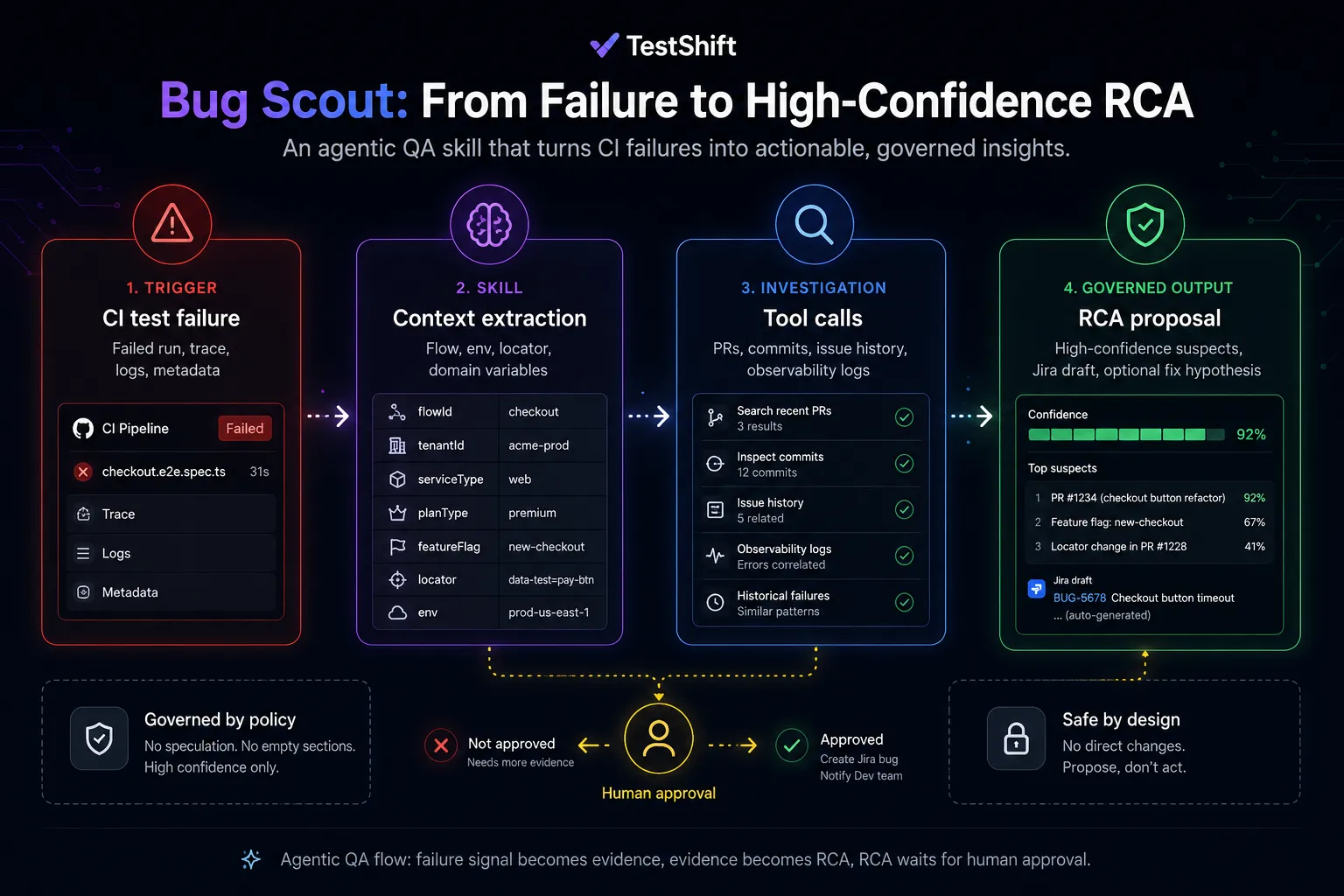
The key word in that diagram is propose.
The agent should not quietly mutate production workflows, open noisy tickets, or push speculative fixes. It should produce a concise, evidence-backed proposal and route it through human approval. That is the difference between agentic assistance and uncontrolled automation.
Lowering the Wall Between Dev and QA
Historically, the role of QA was to hold up a mirror to Development and say:
It is broken.
It was Development’s job to figure out why it was broken and fix it.
That dynamic created bottlenecks, endless Jira ping-pong, and organizational friction: a cycle I detailed in Firefighting vs. Quality Gates.
A dedicated, tool-connected Skill changes the model.
Because the agent can be connected to broader engineering infrastructure through controlled tool access, its potential is enormous.
Deep Log Diving
If the automation test captures an execution ID, the Skill can optionally invoke a cloud logging or observability tool.
It can bypass the UI symptom entirely, fetch backend server logs for that exact session, and surface the real failure:
UI timeout caused by backend
500, traced to SQL constraint violation in payment profile creation.
The Jira ticket no longer says “UI timed out.” It includes the backend evidence that makes the defect actionable.
Product Code Fix Proposals
In a mature workflow, the same agent may identify that the failure stems from a recent PR where a JSON key changed from userId to user_id.
At that point, the agent can do more than open a ticket. It can propose a Draft PR in the relevant repository.
But this is where governance matters.
The Draft PR must be treated as a hypothesis, not a merge-ready truth. It must pass deterministic CI. It must be reviewed by an owner. It must cite evidence from the failing run. It must not silently rewrite tests to hide a product defect.
When QA approaches Development with a verified failure, correlated RCA, backend logs, and a draft fix proposal, the wall between QA and Development becomes lower.
The QA Engineer is no longer a passive gatekeeper.
The QA Engineer becomes a Developer Enabler.
This is not the end of role boundaries. Governance still matters. A proposal still needs human approval. A draft PR still needs deterministic CI and code review.
The deeper shift happens when QA and Development share the same evidence, the same Skills, and the same tool surfaces. The handoff becomes less like a complaint and more like a joint investigation.
The TestShift Philosophy: The Architecture of Trust
In an era defined by the SaaS Apocalypse and infinite code inflation, automation code is being generated at breakneck speed.
Generative AI can produce thousands of lines of Playwright tests in seconds. But as I argued in The Real Quality Gate, writing code is not the hard part. Building a deterministic system of trust is the hard part.
This is where Skills fit into the architecture.
They allow us to embed LLMs into our Quality Gates without handing them final authority.
A mature bug-intake Skill should end with a rule like this:
Before creating a ticket, return the proposal. If the user approves, create the ticket.
That rule is not bureaucracy. It is the control layer.
We do not let the AI run wild. We bind it inside a structured triage loop based on objective evidence: traces, logs, timestamps, commits, and historical defects. The loop culminates in human approval.
At that point, scripting has become Governance.
The Skill is the policy.
The Hard Part: Flakiness, Cost, and Evals
A Bug Scout Skill should not run as an expensive detective on every red build. The economics only work when the system is selective, measurable, and honest about uncertainty.
Flakiness Is the First Classification Problem
Flakiness is the hardest part of CI failure intake because it looks like a product defect until you gather enough history.
A mature Skill should classify every failure into one of four buckets:
| Classification | Meaning | Correct Output |
|---|---|---|
| Product defect | The application probably broke | Jira proposal with evidence |
| Stale automation | The test no longer matches intended behavior | Test-fix proposal |
| Flaky infrastructure | Timing, environment, network, or runner instability | No bug; quarantine or infra ticket |
| Insufficient evidence | The signal is too weak | No ticket; ask for more data |
This distinction protects the organization from the most common failure mode: an agent that opens polished, wrong tickets.
Signals such as “passes on rerun,” “many unrelated tests failed at once,” “runner resource errors,” or “no matching product change in the failure window” should reduce product-defect confidence. A Bug Scout that cannot say “do not open a bug” will become a noise machine.
When the Economics Work
Tool-connected RCA has real cost.
A single investigation that queries GitHub, Jira, observability logs, test artifacts, and an LLM can easily take 30-90 seconds. Depending on model choice, log volume, and tool pricing, it can also cost meaningful money at scale. At hundreds of failures per day, “agentic triage for everything” becomes a budget problem before it becomes a quality strategy.
The practical model is tiered:
- Deterministic pre-filtering groups duplicate failures.
- Cheap rules classify obvious infra noise.
- The Skill runs only on new, recurring, or release-blocking failures.
- Human approval is reserved for high-confidence outputs.
The goal is not to automate curiosity. The goal is to spend reasoning budget where it changes a decision.
How Do You Evaluate a Bug Scout Skill?
You evaluate an RCA Skill the same way you evaluate any production system: against known outcomes.
The strongest approach is to replay historical CI failures where the true root cause is already known, then measure:
- Precision: when the Skill names a suspect PR, how often is it right?
- Recall: how often does it find the real suspect when evidence exists?
- False ticket rate: how often does it create or propose noise?
- Flake classification accuracy: how often does it correctly avoid product bugs?
- Median triage latency: how much time does it save compared to manual triage?
- Cost per accepted ticket: how much reasoning and tool cost produces one useful output?
The hardest part is that ground truth is noisy. Historical Jira tickets often record the developer’s best guess, not verified causation. Your eval ceiling is bounded by the quality of your labels, so the eval set itself needs review.
Without evals, Skills drift just like prompts. They only feel more structured. Measurement is what turns the Skill from a clever instruction file into a governed engineering asset.
Red-Team Audit: Where This Architecture Can Fail
Any serious AI architecture deserves hostile questions.
Here are the risks I would challenge before deploying a Skill like this inside a real enterprise pipeline.
Risk 1: False Confidence
An agent can correlate a failure with a recent PR and still be wrong.
Timing is evidence, not proof. A Skill must label correlation as a suspect, not as certainty. High confidence should require multiple signals: changed files, matching component, matching API, first-fail timing, and reproducibility pattern.
Risk 2: Tool Overreach
Connecting the agent to GitHub, Jira, cloud logs, and observability systems is powerful. It also expands blast radius.
The Skill should use read-only access by default. Write actions, such as Jira creation or Draft PR creation, should happen only through explicit approval and scoped permissions.
Risk 3: Automation Bias
If the ticket looks polished, people may trust it too quickly.
That is dangerous. The Skill should include evidence links, exact run IDs, and confidence boundaries. The human reviewer should be able to validate the claim without reverse-engineering the investigation.
Risk 4: Test-Layer Self-Protection
An AI that owns both the diagnosis and the fix may choose the easiest path: weaken the test.
That is why the Skill must distinguish between product defect, stale automation, flaky infrastructure, and insufficient evidence. Only stale automation should produce a test-fix proposal. Product defects belong in product code or Jira.
This is the heart of TestShift:
AI can reason. Deterministic gates must still decide.
Looking to the Future: Skill Patterns and the Context Architect
Look closely at this Skill pattern.
It contains valuable intellectual property. It encodes how to search, what to filter, where to look, how to rank evidence, and how to present data.
This is Contextual IP.
As more organizations adopt autonomous agents through platforms like GitHub Agentic Workflow or architectures based on WebMCP, a new kind of engineering asset will emerge:
Skill patterns.
The first instinct is to imagine a marketplace of ready-made Skills. That may happen at the edges, but the more realistic model looks closer to ESLint configs, dbt packages, Terraform modules, or testing framework presets.
The valuable part is not a generic artifact you install once. The valuable part is the pattern: how to structure the investigation, where to inject local context, which tools are read-only, which thresholds block output, and which evidence format developers will actually trust.
- A frontend team may adapt a React RCA pattern that knows how to trace hydration failures across routes, logs, and recent component changes.
- DevOps teams may adapt a deployment triage pattern that monitors release verification failures and proposes safe rollback evidence.
- Platform teams may build a CI Doctor pattern that turns raw pipeline exhaust into clean ownership and next-action summaries.
Our role as Software and Quality Architects is mutating right now.
We are transitioning from people who write syntax to people who design cognitive routing.
As code becomes cheap and universally accessible, the differentiator is our ability to formulate the rules of the game: structuring boundaries so machines can execute safely, efficiently, and reliably.
The Skill is not just a useful utility.
It is an early preview of how engineering organizations will encode judgment.
Code is cheap. Context is King. Skills are the new currency.