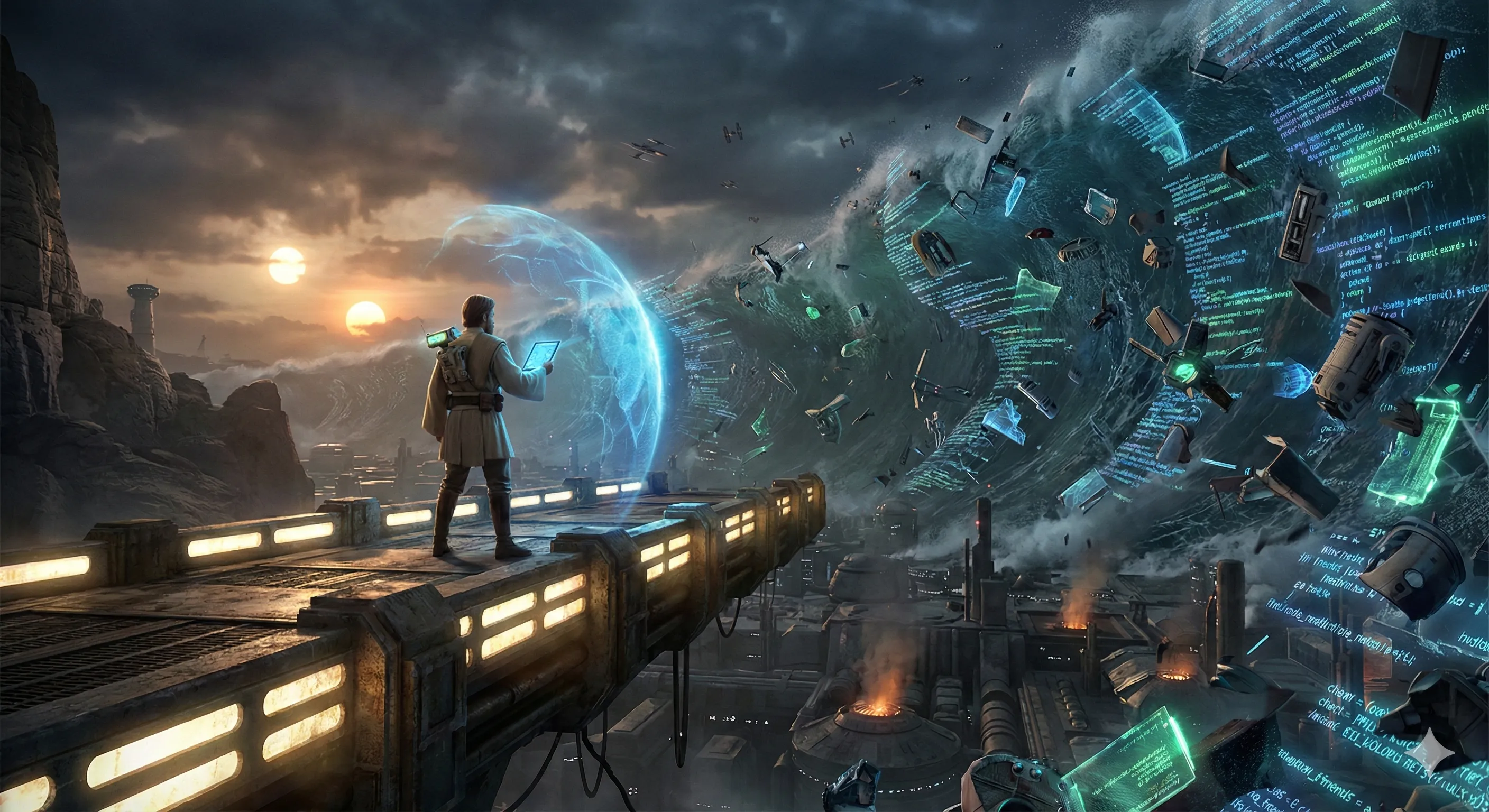
The Automation Paradox in the AI Era
If you are searching for GitHub Agentic Workflow, you are not looking for another generic AI article. You are trying to answer a much more practical question:
How do we let AI automate meaningful repository work without turning our CI/CD platform into an uncontrolled experiment?
That is the real question, and it is now urgent.
As of March 25, 2026, GitHub Agentic Workflows are in technical preview. According to the official GitHub Changelog announcement, they are authored in Markdown, compiled via gh aw compile, and executed through GitHub Actions with a security model built around read-only execution by default and safe outputs for side effects.
This is not “replace YAML with vibes.”
It is a new control surface for repository automation:
- Deterministic triggers and auditability from GitHub Actions
- Natural-language intent for judgment-heavy tasks
- Permission separation for safety
- An operating model that GitHub now frames as Continuous AI
That sounds powerful, and it is. It is also dangerous if you treat it casually.
For months, I have been writing about the SaaS Apocalypse: the era of infinite code inflation, where LLMs generate boilerplate at extreme speed while the cost of verifying reality skyrockets. Up until recently, much of that chaos lived inside the IDE. With GitHub Agentic Workflow, the chaos now has a governed path into the pipeline itself.
And the industry’s first reaction is entirely predictable.
Junior teams imagine a magical future where an AI agent notices a broken Playwright test, rewrites the locator, pushes a fix, opens a pull request, and keeps the release train moving. Enterprise teams see the other side immediately: the same agent can delete assertions, overfit to one flaky run, misread noisy CI logs, or propose a patch that hides the real product defect instead of fixing it.
That is why this topic matters commercially as well as technically. Buyers are no longer asking whether AI can write code. They are asking whether your architecture can govern AI in production.
That is where the difference between a demo and a platform begins.
The Practical Foundation: What GitHub Agentic Workflow Actually Is
The easiest way to misunderstand GitHub Agentic Workflow is to assume it replaces traditional GitHub Actions. It does not.
Traditional GitHub Actions remain the right tool for deterministic work:
- Build
- Test
- Package
- Deploy
- Lint
- Scan
- Enforce policy
Agentic workflows exist for the gray zone: repository work that is repetitive, multi-step, judgment-heavy, and valuable, but awkward to encode as rigid shell scripts. GitHub’s own launch article highlights patterns like issue triage, CI failure investigation, documentation upkeep, reporting, and automated improvement loops.
The official How They Work documentation and Workflow Structure reference make the architecture clear:
- You author the workflow in
.github/workflows/*.md. - You define triggers, permissions, tools, and safe outputs in frontmatter.
- You describe the task in Markdown instructions.
- You compile that source into a
.lock.ymlfile withgh aw compile. - GitHub Actions executes the compiled lockfile.
That architecture matters because it separates intent from execution.
| Layer | What It Does | Why It Matters |
|---|---|---|
| Intent Layer | Natural-language instructions in Markdown | Expresses goals, constraints, tone, and boundaries |
| Capability Layer | Frontmatter configuration | Defines blast radius: permissions, tools, safe outputs |
| Compilation Layer | gh aw compile into .lock.yml | Produces a hardened, reviewable artifact |
| Execution Layer | GitHub Actions runtime | Preserves auditability and enterprise fit |
| Output Layer | Safe outputs and controlled writes | Prevents direct, casual mutation of repo state |
That last row is the real hinge point.
The moment you let a probabilistic agent produce side effects inside your repository, you are no longer talking about convenience tooling. You are talking about governed mutation of software assets.
And once that becomes true, architecture matters more than prompting.
GitHub Agentic Workflow vs. Traditional GitHub Actions
The cleanest mental model is not “old vs new.” It is deterministic lane vs agentic lane.
| Dimension | Traditional GitHub Actions | GitHub Agentic Workflow |
|---|---|---|
| Authoring model | YAML steps | Markdown instructions plus frontmatter |
| Core strength | Deterministic automation | Judgment-heavy repository operations |
| Best output | Exit codes, artifacts, deployments | Issues, comments, pull requests, summaries |
| Risk profile | Scripts fail loudly | Agents can fail plausibly |
| Governance focus | Reliability and performance | Containment, review, cost, and policy |
| Cost driver | Compute time | Compute plus premium model usage |
| Best owner | CI/CD and platform teams | Platform, quality, and governance teams together |
This distinction is extremely important for teams in Playwright or test automation-heavy environments.
Your Playwright Quality Gate should remain deterministic. If a test fails, it blocks the pull request. No discussion. No creativity. No interpretation.
Your GitHub Agentic Workflow belongs next to that gate, not inside it. It should investigate, summarize, categorize, and propose. It should not be the final authority on whether code merges.
This is the same architecture principle I argued for in Building a Quality Gate for Your Automation Project and later extended in The Real Quality Gate: deterministic systems own release authority; probabilistic systems can support them, but they do not replace them.
The Pipeline View: From Markdown Intent to Governed Side Effects
Here is the production architecture that matters more than the syntax itself:
flowchart TD
    A["Trigger<br/>issue, PR, schedule, workflow_run"] --> B["Workflow source<br/>.github/workflows/*.md"]
    B --> C["Compilation<br/>gh aw compile"]
    C --> D["Lock file<br/>.lock.yml"]
    D --> E["GitHub Actions runtime"]
    E --> F["Read-only agent job"]
    F --> G["Detection and policy checks"]
    G --> H["Safe outputs job"]
    H --> I["Comment, issue, PR, or dispatch"]
This is the architectural line between “interesting preview feature” and “enterprise candidate.”
GitHub’s official security architecture and compilation process explicitly describe the separation of jobs in the compiled workflow. The important point is not just that the agent runs. The important point is how it runs:
- The agent phase is constrained
- Detection and policy enforcement are separate
- Safe outputs handle side effects
- The entire flow remains observable inside GitHub Actions
That is exactly the kind of design enterprise buyers want to see. It does not rely on trust in a model. It relies on boundaries.
The Hard Pivot: From Tooling to Production Reality
Everything above explains how GitHub Agentic Workflow works. It explains the syntax, the compilation step, and the security posture.
None of that, by itself, explains what happens when you place an autonomous coding system into a live CI/CD environment.
That is where the conversation gets serious.
If you allow a probabilistic coding agent to mutate your test layer without a deterministic quality gate, you are not building automation. You are building a Rollback Storm.
Why? Because LLMs do not optimize for engineering truth. They optimize for plausible completion. In a pipeline, that can translate into very specific failure modes:
- Deleting an assertion to make a run green
- Overfitting a locator to one DOM snapshot
- Masking a race condition with longer waits
- Misunderstanding flaky infrastructure as a product defect
- Proposing an unnecessary refactor because the prompt left too much freedom
This is why the real architectural pivot is not from YAML to Markdown.
It is from tooling to governance.
You cannot manage an LLM in CI/CD the way you manage a Bash script. A Bash script does exactly what you encoded. An agent reasons over messy evidence, incomplete context, and probabilistic next-token choices. That means your job is no longer merely to automate execution. Your job is to define the boundaries within which automated reasoning is allowed to operate.
That is the purpose of the TestShift Iron Dome framework.
The TestShift Iron Dome Framework: The Three Laws of Agentic CI
To deploy GitHub Agentic Workflow safely in an enterprise pipeline, I recommend three non-negotiable laws.
Law 1: The Two-Lane Architecture
Never place the agent inside the deterministic release gate.
If you inject non-deterministic reasoning directly into the synchronous pull_request validation path, you degrade the one thing developers need most: fast, reliable feedback.
The right design is a Two-Lane Architecture:
- Lane A: The deterministic quality gate
- Lane B: The asynchronous agentic sidecar
flowchart TD
    classDef deterministic fill:transparent,stroke:#3b82f6,stroke-width:2px;
    classDef agentic fill:transparent,stroke:#8b5cf6,stroke-width:2px;
    classDef spacer fill:transparent,stroke:transparent,color:transparent;

    subgraph LaneA ["Lane A: Deterministic Gate (Synchronous)"]
        PR["Pull Request Created"] --> PW["Run Playwright / CI checks"]
        PW --> Gate{"All checks green?"}
        Gate -- Yes --> Merge["Allow merge"]
        Gate -- No --> Block["Block PR"]
    end

    subgraph LaneB ["Lane B: Agentic Sidecar (Asynchronous)"]
        SpacerB[" "]:::spacer
        Block -.-> SpacerB
        SpacerB --> Fail["workflow_run: failure"]
        Fail --> GAW["GitHub Agentic Workflow<br/>CI Doctor"]
        GAW --> Summarize["Fetch logs, traces, metadata"]
        Summarize --> Reason["Agent reasons over curated evidence"]
        Reason --> Propose["Create issue or draft PR proposal"]
    end

    Propose -.-> Retry["Deterministic CI reruns on new branch"]
    Retry -.-> PR

    class PR,PW,Gate,Merge,Block,Retry deterministic;
    class Fail,GAW,Summarize,Reason,Propose agentic;
Lane A is the muscle: fast, rigid, ruthless, and deterministic.
Lane B is the brain: slower, interpretive, and useful precisely because it is not entrusted with final merge authority.
This separation is the difference between operational intelligence and operational chaos.
Law 2: The Safe Outputs Firewall
The second law is containment.
GitHub’s safe outputs model exists for a reason. The compiled architecture separates the read-only agent phase from the write-capable phase. In practical terms, the agent should not enjoy broad, casual write authority over your repository.
| Stage | Responsibility | Security Intention |
|---|---|---|
| Agent job | Read context, inspect evidence, reason | Minimal permissions, no uncontrolled writes |
| Detection job | Evaluate content, threats, policy violations | Catch risky output before mutation |
| Safe outputs job | Perform allowed side effects | Constrain how comments, issues, or PRs are created |
That means your workflow contract should explicitly define the blast radius. Here is an Astro-compatible Markdown example that captures the architectural pattern while staying aligned with the official GitHub docs:
---
on:
  workflow_run:
    workflows: ["Pre-Merge Quality Gate"]
    types: [completed]

permissions:
  contents: read
  pull-requests: read
  actions: read

safe-outputs:
  create-pull-request:
    allowed-files:
      - "tests/**"
    protected-files: blocked
    fallback-as-issue: true

tools:
  github:
---

# CI Doctor

When the deterministic quality gate fails, analyze the failed run and decide
which of these outcomes is correct:

- Create an issue when the failure is probably a product defect
- Create an issue when the evidence is too weak
- Create a pull request only when the failure is clearly a stale test or flake

Never modify files outside `tests/**`.
Every claim must cite the failing workflow run, test name, or stack trace.
Notice what this contract does:
- It narrows repository mutation
- It blocks sensitive file classes by policy
- It falls back to an issue when a PR is not appropriate
- It forces the agent to choose between diagnosis and repair
If you also enable Bash access, treat it as a falsification tool, not a free-form coding surface. Let the agent rerun one failing Playwright spec or inspect one artifact. Do not give it open-ended shell freedom and call that architecture.
Law 3: Token Economics and DataOps
CI/CD environments are actively hostile to context windows.
A failed Playwright run can generate megabytes of console output, screenshots, HTML fragments, traces, stack dumps, and screenshots. If you naively pipe that raw exhaust into an agent, you will get three things:
- Token waste
- Slower runs
- Worse reasoning due to attention dilution
You need a DataOps layer before the agent wakes up.
| Input Strategy | What the Agent Sees | Cost Profile | Result Quality |
|---|---|---|---|
| Raw CI exhaust | Full logs, raw HTML, trace noise | High | Often worse due to noisy context |
| Curated failure summary | Failing tests, exact assertion, top stack frames, trace link | Low to moderate | Much stronger |
| Structured evidence bundle | JSON summary plus selected artifacts | Best | Highest signal-to-noise ratio |
In practice, that means you should use deterministic GitHub Action steps before the agent job to compress reality into something useful.
For example:
{
  "workflow": "pre-merge-quality-gate",
  "failing_spec": "checkout.spec.ts",
  "test_name": "guest checkout confirms payment",
  "assertion": "expected heading 'Order Confirmed' to be visible",
  "error": "locator resolved to hidden element",
  "stack_top": "tests/checkout.spec.ts:88:17",
  "trace_url": "https://github.com/org/repo/actions/runs/123456789"
}
That JSON is dramatically more useful than 5 MB of raw logs.
Never force an LLM to perform deterministic parsing tasks that jq, TypeScript, Python, or plain GitHub Actions steps can perform faster, cheaper, and more accurately.
This point connects directly to my earlier argument in Code Is Cheap, Context Is King: the true bottleneck in agent systems is not code generation. It is context discipline.
Preempting the Skeptics: The Red Team Audit
A good architecture should survive hostile questions. Here are the three pushbacks leadership will usually raise, and why they do not invalidate the model.
”This bureaucracy kills speed.”
Only if you optimize for one developer’s short-term convenience instead of the whole R&D system.
The Iron Dome is designed for scale. In a large organization, the cost of one hallucinated “fix” hitting the wrong branch is far greater than the cost of one governed, asynchronous repair loop. The agent is a noise cleaner, not an unreviewed typist.
”If the agent is limited to test files, it will just hack the test to make it green.”
That is exactly why the agent must be prompted as a diagnostic system first and a repair system second.
Its job is to classify the failure:
- Product defect
- Stale test
- Flaky test
- Insufficient evidence
Only one of those paths should produce a pull request, and even then the deterministic gate must rerun afterward.
”We just replaced TypeScript maintenance with prompt maintenance.”
No. You moved one layer up the stack.
Test code changes every sprint because product behavior changes every sprint. Workflow policy should change much less often. A good GitHub Agentic Workflow is not daily micromanagement. It is quarterly governance encoded as Markdown.
That is the real leverage: moving from line-by-line scripting to organization-level policy design.
One More Operational Trap: Triggering CI on Agent-Created Pull Requests
There is one operational detail too many teams miss on the first implementation.
Actions performed by the default GITHUB_TOKEN do not normally trigger downstream push and pull_request workflows. That means your GitHub Agentic Workflow can successfully create a pull request and still fail to trigger your deterministic validation pipeline on that branch.
GitHub documents this directly in the official FAQ. If you want the downstream CI to trigger automatically, you should configure GH_AW_CI_TRIGGER_TOKEN so the workflow can create an additional commit that causes your standard pipeline to run. If you skip this, you can end up with agent-created pull requests that look valid but have never passed the real gate.
This is not a minor implementation detail. It is part of the governance chain.
The correct operating model is:
- The agent proposes.
- The deterministic gate reruns.
- Human review decides.
Never let a probabilistic system control the final gate that validates deterministic software behavior.
What to Automate First
Teams often fail with new AI infrastructure because they start with the highest-risk use case.
Do not begin with autonomous feature implementation.
Start here instead:
| Maturity Stage | Recommended Use Cases | Why Start Here |
|---|---|---|
| Stage 1 | daily repository reports, issue triage, CI summaries | Low blast radius, high visibility |
| Stage 2 | documentation PRs, stale test cleanup, ownership suggestions | Useful write actions with bounded risk |
| Stage 3 | flaky-test remediation, narrow refactors, test-only PRs | Requires mature review and rerun discipline |
| Stage 4 | broader code-generation loops | Only after governance, metrics, and acceptance rates are healthy |
If your company already uses Playwright, the best first high-value pattern is often a CI Doctor sidecar:
- The deterministic Playwright gate fails
- Deterministic steps summarize the failure
- GitHub Agentic Workflow investigates
- The output becomes an issue or a tightly constrained pull request
- CI reruns on the new branch
- A human reviewer decides
That is a strong architecture because it combines the exact strengths of both worlds:
- Playwright validates product reality
- GitHub Actions enforces deterministic process
- The agent contributes reasoning where reasoning is actually useful
Conclusion: Prompt as Policy
The era of the script writer is ending.
If your value proposition is manually translating repository noise into automation syntax, compiled workflows and coding agents will commoditize that work very quickly. The new value hierarchy is different:
- Code generation is cheap
- Execution must remain deterministic
- Control becomes the premium capability
That is why GitHub Agentic Workflow is not, by itself, the story.
The story is what kind of architecture you build around it.
If you implement it as a governed sidecar, pair it with deterministic quality gates, control its blast radius with safe outputs, compress context before reasoning, and force every proposed repair back through the same hard validation pipeline, then Continuous AI becomes an asset.
If you implement it lazily, it becomes a faster way to generate expensive noise.
That is the point of the Iron Dome. Not to stop automation, but to make it survivable.
Architecture > Magic.